

An SEO content brief is a one or two page plan that tells the writer what the page must achieve, who it is for, which searches it targets, what it must cover and how it should be structured. To write one, you pick the keyword and intent, study what already ranks, decide the angle only you can offer, then set the outline, questions, links and success measure before anyone writes a word.
A good brief is the cheapest way to avoid a rewrite. Most content we are asked to fix did not fail because the writing was bad. It failed because nobody agreed what the page was for. This guide walks through each part of a brief with a worked example: a page for Coastline Plumbing, a fictional plumber in Austin, Texas, comparing tankless and tank water heaters.
What a content brief is for
A content brief does three jobs:
- It makes the decisions before the writing. Topic, intent, angle and scope are settled while changes are cheap.
- It gives the writer what they cannot easily find. Customer questions, the business’s real experience, internal pages to link, things not to say.
- It sets a standard to review against. The editor checks the draft against the brief, not against personal taste.
Briefs matter more, not less, when AI drafts the first version. A model given “write about tankless water heaters” produces the same article as everyone else. A model given a brief with the business’s prices, installation experience and customer questions produces something worth ranking.
Step 1: Set the goal, keyword and intent
Start with the business reason for the page. Then pick the main keyword and confirm the intent.
- Goal: Coastline wants more tankless installation jobs, which have a higher ticket than tank replacements.
- Main keyword: “tankless vs tank water heater”.
- Secondary keywords: “is a tankless water heater worth it”, “tankless water heater pros and cons”, “tankless water heater cost Austin”.
- Search intent: commercial investigation. People are deciding, not yet buying.
Check the keyword against your keyword map before going further. If another page already targets the same search, update that page instead, or you create keyword cannibalization.
Keyword research gives you volume and difficulty for each candidate. RankThat’s Keyword research shows volume, difficulty and intent per keyword and can group keywords that a single page can rank for, which is a quick way to see which secondary terms belong on this page.
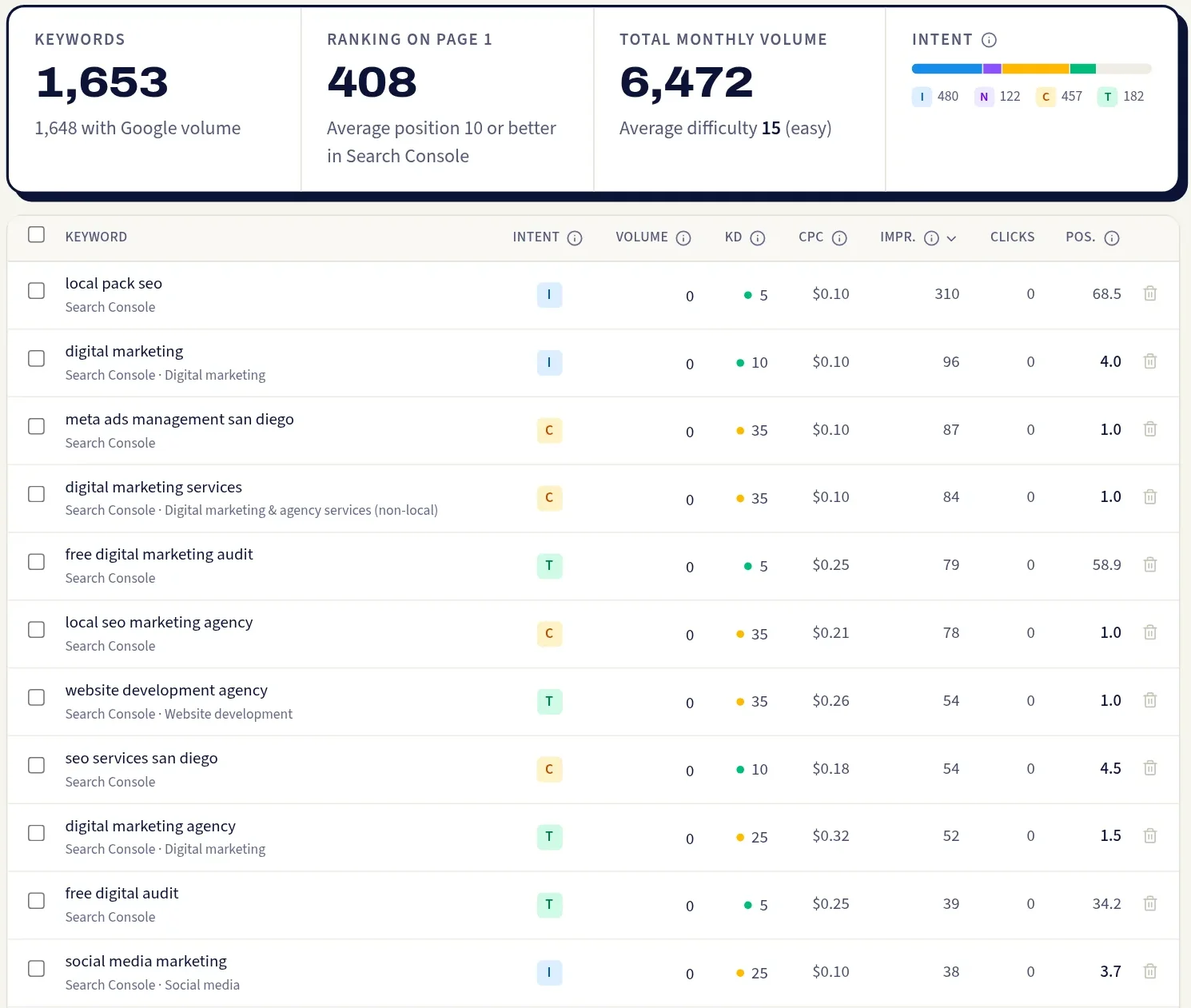 Keyword research in RankThat: volume, difficulty and intent for each keyword, the starting point for a brief.
Step 2: Study what ranks now
Search the main keyword and open the top five to eight results. You are looking for patterns, not something to copy.
| Look at | Why | What Coastline found |
|---|---|---|
| Page types | Tells you what Google thinks the intent is | Comparison articles from plumbers and manufacturers, one big home improvement site |
| Format | Sets reader expectations | Most use a comparison table and a pros and cons list |
| What they all cover | The minimum a complete page needs | Upfront cost, running cost, lifespan, endless hot water, flow rate |
| What they miss | Your chance to add something | No local installation costs, no mention of Austin’s hard water and descaling, little on gas line upgrades |
| SERP features | Space you could win | People also ask box, a featured snippet with a short comparison |
Write the gaps down. They become the angle.
Note the People also ask questions too. They are the follow-up questions real searchers have, and a good page answers them.
Step 3: Decide the angle and what only you can add
This is the part most briefs skip, and the part that decides whether the page ranks. Google’s guidance on helpful, people-first content asks whether a page provides original information or analysis and adds value beyond what other pages offer. In SEO shorthand, that is information gain.
For Coastline, the angle is: a local plumber’s honest answer, with Austin prices and the problems we see after installation. What only they can add:
- Real installed price ranges from their own jobs this year, for both types
- How hard water in the area affects tankless units, and how often they descale them
- When they talk customers out of tankless (small households with low use, homes that need a costly gas line upgrade)
- Photos of a real installation and a scaled-up heat exchanger
If you cannot list at least two or three things like this, the page will probably be another average article. Go back to the business and ask.
Step 4: Write the outline
Give the writer the H2s and H3s, each with a line about what it must cover. Phrase headings the way people ask the question.
- H2: Tankless vs tank water heaters: the short answer. Two sentences and a comparison table.
- H2: How much each costs to buy and install in Austin. Coastline’s price ranges, what drives the difference.
- H2: Running costs and lifespan. Energy use, typical lifespan of each, maintenance.
- H2: Hot water supply: flow rate vs tank size. What “endless hot water” really means, sizing by household.
- H2: Hard water and tankless heaters. Descaling, water softeners, warranty conditions.
- H2: When we recommend each. Three short scenarios.
- H2: FAQ. Four questions from People also ask and the office phone log.
- Call to action: book an in-home quote.
Add the entities and terms an expert would expect: BTU, gallons per minute (GPM), first-hour rating, anode rod, venting, condensing and non-condensing units. Our guide to semantic SEO explains how to map these. List them so the writer covers them, not so they get sprinkled in.
Step 5: Fill in the rest of the brief
The remaining fields are quick but stop common problems.
- Audience and reading level. Homeowners, not plumbers. Explain GPM the first time it appears.
- Tone. Plain and honest. Coastline’s voice is “the plumber who tells you not to buy the expensive thing if you do not need it”.
- Length. A range based on what the topic needs and what ranks, such as 1,400 to 1,800 words. Length is an outcome of coverage, not a goal.
- Title tag and meta description drafts. For example: “Tankless vs Tank Water Heater: Costs in Austin (2026) | Coastline Plumbing”. See title tag.
- Internal links. To the tankless installation service page, the water heater repair page and the hard water guide. Name the anchor text.
- Sources. Manufacturer spec sheets, the Department of Energy page on water heaters, and Coastline’s own job data. No made-up statistics.
- Expert and reviewer. Who provides the experience, and who checks the facts. For Coastline, the lead installer reviews the draft. See E-E-A-T.
- Images. The installation photo, a scaled heat exchanger, a simple diagram.
- What not to say. No promises of specific savings, no brand bashing, no prices that are not current.
- Success measure. Rankings for the main and secondary keywords, and quote requests from the page.
The brief at a glance
A summary block at the top lets anyone see the decisions in ten seconds:
| Field | Coastline example |
|---|---|
| Page | New blog guide, /blog/tankless-vs-tank-water-heater/ |
| Goal | More tankless installation quote requests |
| Main keyword | tankless vs tank water heater |
| Intent | Commercial investigation |
| Angle | Local plumber’s honest answer with Austin prices and hard water advice |
| Unique value | Own price ranges, descaling experience, when we advise against tankless |
| Length | 1,400 to 1,800 words |
| Must link to | Tankless installation, water heater repair, hard water guide |
| Reviewer | Lead installer |
| Measure | Rankings for the keyword group, quote form submissions |
Step 6: Review the draft against the brief
When the draft comes back, review it in this order:
- Intent and angle. Does it answer the decision the searcher is making, with the angle agreed? If not, nothing else matters yet.
- Coverage. Every outline section, every question, the key entities.
- Unique value. Are the prices, experience and photos actually in it, or did they get lost?
- Accuracy. The expert checks every claim and number.
- On-page details. Title, meta description, header tags, internal links, image alt text.
Then publish, and after four to eight weeks check Search Console for the queries the page gets. Queries you did not expect often point to the next section to add, or the next page to write.
Building briefs in RankThat
RankThat’s Content section generates a content brief from a keyword. The brief includes a focus keyword, primary, secondary and related keywords, the search intent, content type, a target word count, tone and style, an H2 and H3 outline with keywords for each section, key points and FAQ questions with guidance on the answer. Where it finds them, it also lists competitor articles for the keyword. You edit any field, export the brief to Google Docs, or generate a draft article from it in your brand voice.
The tool does the research and structure. The angle and the unique value in steps 3 and 5 still have to come from the business, and that is where we spend most of our time on client briefs.
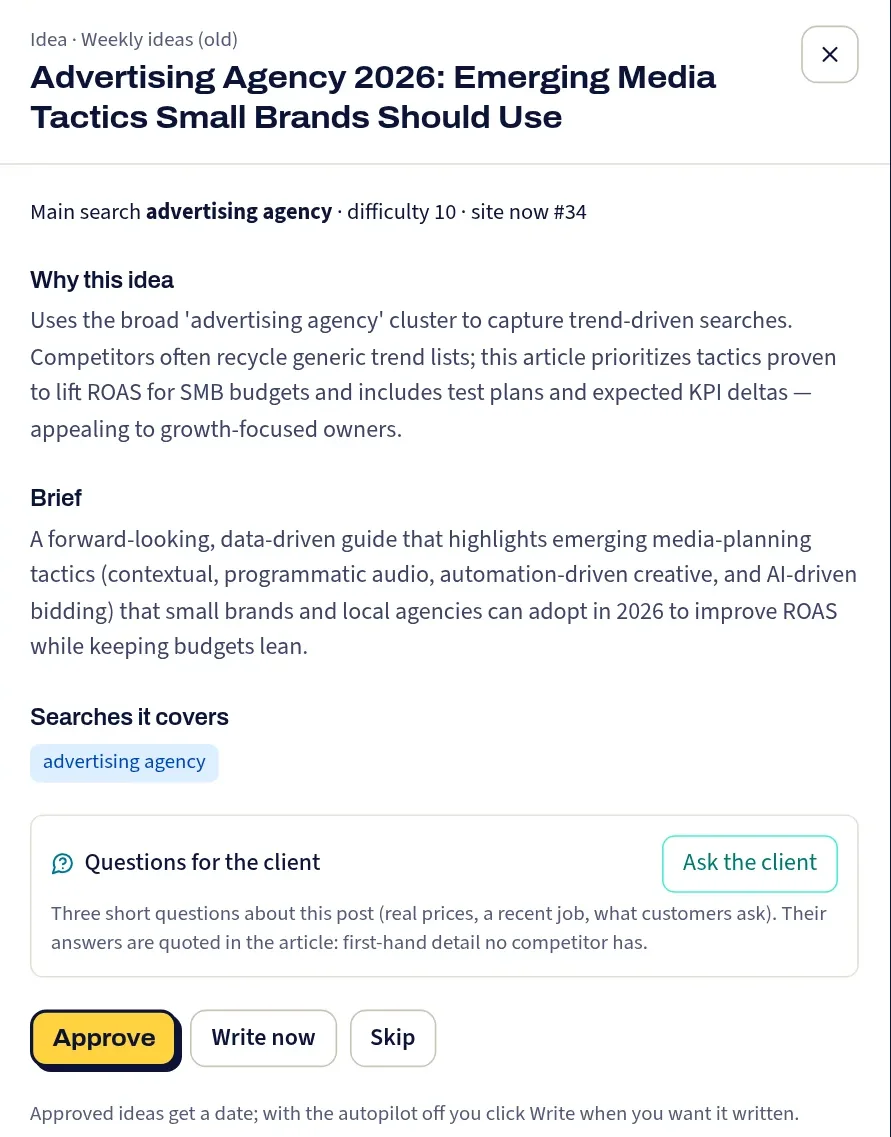 An idea in RankThat’s Content Plan: the main search, why it was picked and the brief, before the article is written.
Common mistakes
- A keyword and a word count, nothing else. That is an order, not a brief.
- Copying the top result’s outline. The page ends up as a weaker copy.
- No unique value section. The single most common reason briefed pages still do not rank.
- Too long a brief. If it is longer than the article, nobody reads it. One or two pages is right.
- No owner for review. Briefs that nobody checks the draft against become suggestions.
FAQ
What should an SEO content brief include?
The goal, main and secondary keywords, search intent, audience, angle and unique value, an outline with headings, questions to answer, key terms, length range, title and meta description drafts, internal links, sources, reviewer and how success is measured.
How long should a content brief be?
Usually one to two pages. Enough for the writer to make no major decisions alone, short enough to read in five minutes.
Who should write the content brief?
Whoever owns the SEO strategy, usually an SEO lead or content strategist, with input from someone at the business who knows the subject. The writer should be able to ask questions before starting.
Do I need a brief for every page?
For any page you want to rank, yes. A short brief for a small update can be five lines. The bigger the page and the more competitive the search, the more detail it needs.