

Semantic SEO means writing a page so it covers the whole topic a searcher has in mind: the things (entities) involved, how they relate, and the questions people ask next. Instead of repeating one keyword, you name the right concepts precisely, answer the follow-up questions and link related pages, so Google and AI assistants can tell exactly what the page is about and which searches it answers.
Our semantic SEO glossary entry covers the definition. This guide is the process we use when we plan and rewrite content for clients, step by step, with one worked example: a cold brew guide for Bean & Barrel Coffee, a fictional WooCommerce store selling beans and brewing gear.
Why keywords alone stopped working
Google has been matching meaning rather than exact words for over a decade. Its guide to ranking systems describes several of the systems involved:
- RankBrain helps Google understand how words relate to concepts, so it can return a relevant page that does not use the exact words searched.
- Neural matching connects concepts in queries with concepts in pages.
- BERT helps Google understand how combinations of words express different meanings and intent.
- Passage ranking lets Google judge individual sections of a page, not only the page as a whole.
Google also keeps a Knowledge Graph of entities: people, places, businesses, products and concepts, each with known attributes and relationships. When a page names entities clearly and connects them correctly, it is easier to match to the many ways people search for the same thing.
AI search works the same way, only more so. In AI Mode and AI Overviews, Google can split one question into several related searches (query fan-out) and pull passages from different pages to answer each part. A page that covers the topic well has more passages that answer those sub-questions. Our guide on showing up in AI Overviews covers that side in detail.
The practical result: a page that covers “cold brew” thoroughly can rank for “how to make cold brew”, “cold brew ratio”, “cold brew vs iced coffee” and dozens of variations without targeting each one, while a page that repeats “best cold brew coffee” twenty times often ranks for none.
Step 1: Define the topic and the searcher
Start with a topic and an intent, not a keyword.
- Topic: making cold brew coffee at home.
- Searcher: someone who has tried cold brew from a cafe and wants to make it cheaper at home.
- Search intent: informational, with a commercial edge (they may need beans and a brewer).
- Job of the page: get them to a good first batch, and show which beans and gear help.
Then search the main phrases yourself and look at what ranks. If the top results for “cold brew” are recipes with ratios and steep times, a product category page will not compete for it. That decides the page type before you write a word.
Step 2: Map the entities
List the things a knowledgeable person would expect the page to mention. We group them in three rings:
| Ring | What it is | Cold brew example |
|---|---|---|
| Core entities | What the topic is made of | Cold brew, coffee beans, grind size, coffee-to-water ratio, steep time, concentrate, filtering |
| Related entities | What a reader compares or connects it to | Iced coffee, Japanese iced coffee (flash brew), nitro cold brew, caffeine, acidity |
| Tools and products | What people use | Mason jar, French press, cold brew maker, burr grinder, paper and mesh filters, specific roasts |
Where to find them:
- The top-ranking pages. Note the concepts all of them mention. Those are table stakes.
- People also ask and related searches for the main phrases.
- Google autocomplete. Type the topic and each letter of the alphabet after it.
- Your own team and customers. Bean & Barrel’s support inbox had the question nobody ranking covered well: why homemade cold brew tastes sour.
RankThat’s Keyword research can start from a few seed keywords and collect Google autocomplete, People also ask and related searches in one list, with volume and intent for each.
Do not stuff every entity in. The point is to know what a complete answer includes, then decide what this page covers and what belongs on a linked page.
Step 3: Turn questions into structure
Each main sub-question becomes a heading, phrased the way people ask it. Each heading is answered directly in its first sentence or two, then expanded.
The outline for Bean & Barrel’s guide:
- What cold brew is (and how it differs from iced coffee)
- The best coffee-to-water ratio for cold brew
- What grind size to use
- How long to steep cold brew
- Step by step: making a batch in a jar or French press
- Concentrate vs ready to drink: how to dilute
- Why your cold brew tastes sour, bitter or weak
- Which beans work best
- How long cold brew keeps in the fridge
- Cold brew vs nitro vs Japanese iced coffee
A few formatting habits help both readers and passage-level ranking:
- Answer first. “Use a ratio of about 1:5 for concentrate” before the explanation, not after three paragraphs of history.
- Tables for comparisons. Cold brew vs iced coffee by method, time, taste and caffeine fits a table better than prose.
- Numbered steps for procedures. HowTo rich results are gone, but numbered steps are still the clearest format for people and for AI answers.
- Specific numbers and names. “Steep 12 to 18 hours at room temperature” is more useful, and more quotable, than “steep for a while”.
Step 4: Name entities clearly and consistently
Semantic clarity is mostly careful writing:
- Use the full, standard name at least once. “Japanese iced coffee (also called flash brew)” rather than only “flash brew”.
- Disambiguate. “Nitro cold brew, cold brew infused with nitrogen gas” tells a reader and a machine what you mean in one line.
- State relationships. “Cold brew uses time instead of heat to extract coffee” connects the entity to its defining attribute.
- Keep terms consistent. If you call it “concentrate” in one section, do not switch to “base” and “stock” in others without saying they are the same.
- Show first-hand experience. Bean & Barrel’s guide includes their own test batches at 12, 16 and 20 hours with tasting notes. That is something no competitor page has, which is what information gain means in practice.
Google’s guidance on creating helpful, reliable, people-first content asks whether content provides original information, research or analysis, and whether it provides a substantial, complete description of the topic. Entity coverage handles the second. Your own tests, photos and numbers handle the first.
Step 5: Add structured data where it fits
Structured data tells search engines explicitly which entities a page is about. For a guide like this:
Article(orBlogPosting) with the author, dates and publisherOrganizationfor the business, withsameAslinks to its official profilesProducton the product pages the guide links to, not on the guide itself
{
  "@context": "https://schema.org",
  "@type": "Article",
  "headline": "How to make cold brew coffee at home",
  "author": { "@type": "Person", "name": "Sam Ortega" },
  "publisher": { "@type": "Organization", "name": "Bean & Barrel Coffee" },
  "about": [
    { "@type": "Thing", "name": "Cold brew coffee" }
  ],
  "datePublished": "2026-11-22"
}
Schema does not make a thin page rich. It labels what is already on the page. See schema markup for which types Google uses for rich results today.
Step 6: Connect the page to related pages
Semantic SEO works at site level as well as page level. A cold brew guide is stronger when it sits in a group of pages about the same area and they link to each other with descriptive anchors:
- Up to a broader page: “Brewing guides” or “How to brew coffee at home”.
- Across to siblings: French press guide, iced coffee guide, grind size guide.
- Down to products: medium-dark roast beans for cold brew, the cold brew maker, the burr grinder.
That structure is a topic cluster. Over time, it is how a site becomes the obvious source on a subject, which is what people mean by topical authority.
Step 7: Check coverage before you publish
Before publishing, compare the draft with your entity map and the top-ranking pages:
- Does it answer every main question in the outline, near the top of its section?
- Does it name the core entities and the related ones a reader expects?
- Does it add something the ranking pages lack (tests, numbers, photos, a clearer method)?
- Would an expert in the subject find anything wrong or missing?
- Does every section earn its place, or is some of it there only for length?
A content brief makes this check easy, because the entities, questions and outline are agreed before anyone writes. Our guide on how to write a content brief shows how to build one. In RankThat, a content brief lists the focus keyword, related terms, the H2 and H3 outline with keywords per section, and FAQ questions with guidance on how to answer them.
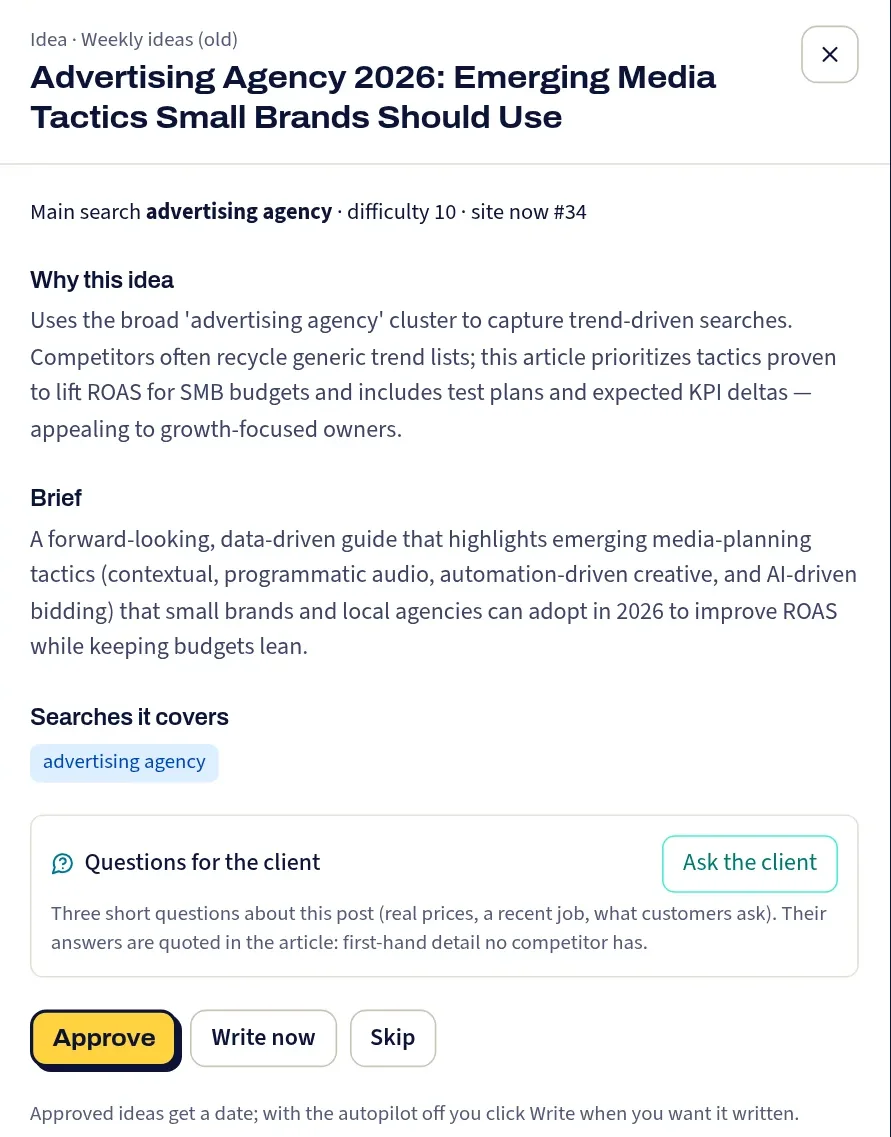 An idea in RankThat’s Content Plan: the brief and the searches it covers are set before writing starts.
After publishing, watch Search Console for the queries the page picks up. A well-covered page usually starts collecting impressions for variations you never targeted. Gaps show up as related questions that bring impressions but few clicks, which tells you which section to expand.
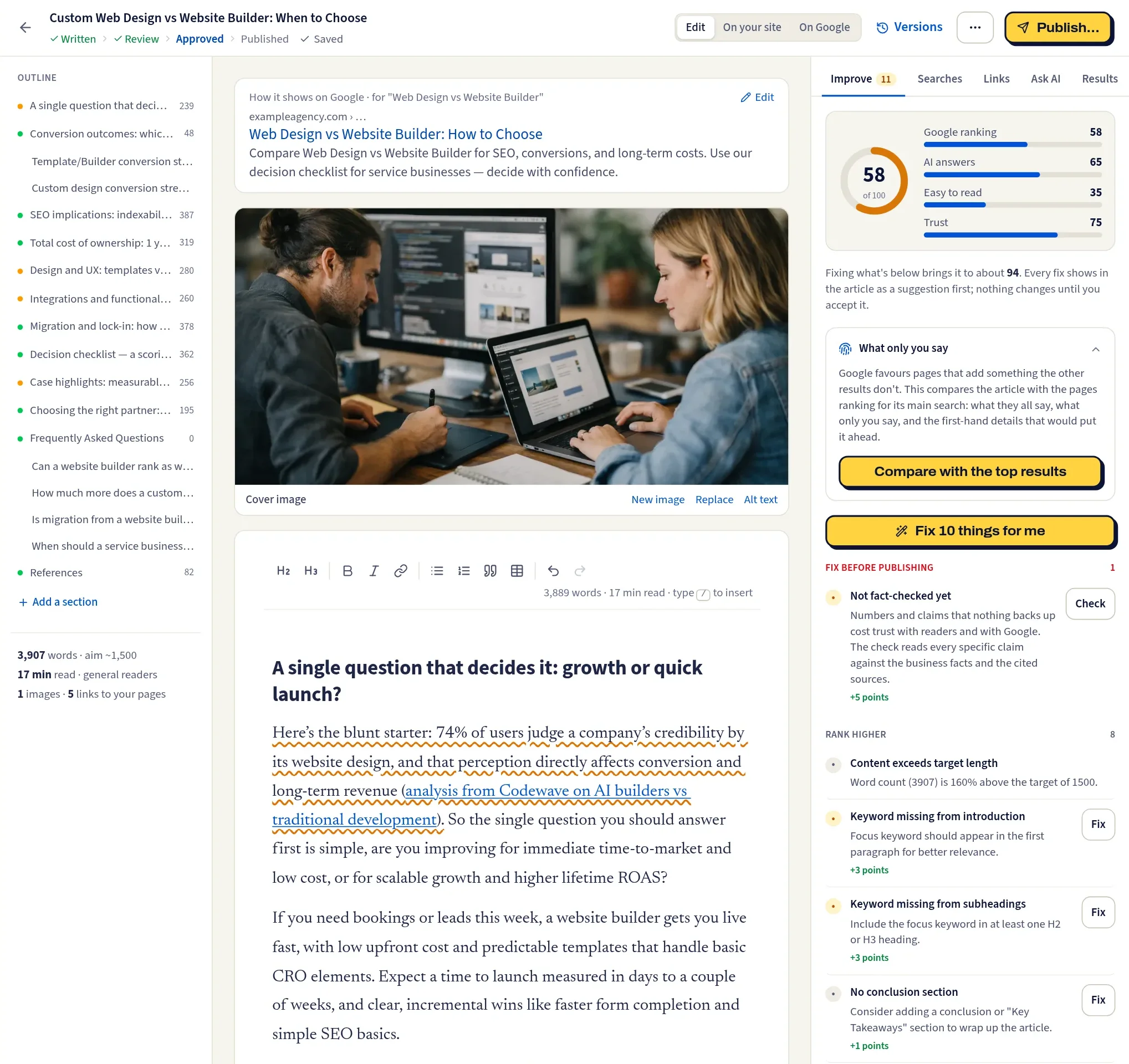 The article editor in RankThat. The coach scores the draft for Google, AI answers, readability and trust, and lists what to fix before it goes live.
Common mistakes
- Treating “related keywords” as a list to sprinkle in. Entities should appear because the explanation needs them.
- Covering everything on one page. If a sub-topic needs 800 words, give it its own page and link to it.
- Copying the top results’ outline exactly. You match them at best. Add what only you know.
- Vague language. “Various factors affect the taste” says nothing. Name the factors.
- Forgetting the reader’s next step. Semantic coverage still needs a clear path to the product or service.
FAQ
Is semantic SEO different from normal SEO?
It is a way of doing on-page and content SEO, not a separate discipline. Keywords still matter for choosing topics and wording. Semantic SEO changes how you cover them: by topic, entities and questions instead of by repeated phrases.
Are LSI keywords part of semantic SEO?
“LSI keywords” is a common name for related terms. Latent semantic indexing is an old information retrieval method, and Google has not said it uses it. What matters is naming the concepts a complete answer needs, whatever you call them.
Do I still need a target keyword?
Yes, as the main way people describe the topic. Use it in the title, the H1 and early on the page. Then let the rest of the page cover the topic naturally rather than repeating it.
Does semantic SEO help with AI search?
It helps. AI Overviews, AI Mode and assistants like ChatGPT answer with passages that explain a specific point clearly. Pages built around clear questions, precise entities and direct answers give them more of those passages to use.