

You build topical authority by covering a subject more completely and more usefully than other sites: pick a small number of topics that matter to your business, plan a cluster of pages for each one around a pillar page, link them tightly, fill the gaps competitors leave and keep the pages up to date. Over time, Google and readers start treating the site as a go-to source for that subject, and new pages in the cluster rank faster.
“Topical authority” is an industry term, not a score Google publishes. But the effect is easy to see on client sites: a site with twenty connected, accurate pages on one subject outranks a bigger site with one page on it. This guide covers how we plan and build that, using Brightside Dental, a fictional practice with three locations around Columbus, Ohio, as the example.
What topical authority means in practice
Topical authority is the trust a site earns on a subject by covering it thoroughly, accurately and from real experience. It shows up as:
- New pages on the topic getting indexed and ranking faster
- Pages ranking for many related searches they never targeted by name
- The site appearing more often in AI answers and featured snippets on that subject
- Links and mentions arriving because the content is the reference people cite
It rests on the same things Google’s guidance on helpful, people-first content asks for: content that demonstrates first-hand expertise, gives a substantial and complete description of the topic and leaves the reader feeling they have learned enough to reach their goal. Authority on a topic is that, repeated across every page in it.
Step 1: Choose your topics
Most sites try to cover too much. Pick topics where three things overlap:
- The business makes money from it. Brightside earns most from implants, aligners and children’s dentistry.
- You have real expertise. Their dentists place implants every week and can explain the hard cases.
- People search for it in many ways. Implants alone have searches on cost, pain, recovery, bone grafts, alternatives, insurance and eligibility.
Brightside chose three topics for the year: dental implants, clear aligners and children’s dentistry. Cosmetic whitening came fourth and waited. A small site doing three topics well beats one doing twelve thinly.
Step 2: Map each topic into a cluster
A topic cluster is a group of pages on one subject: a pillar page covering the topic broadly, and cluster pages each covering one sub-topic in depth, all linked together.
To find the sub-topics:
- Collect the searches. Keyword research tools, Google autocomplete, People also ask and related searches, plus Search Console queries you already get impressions for.
- Group them by intent. Searches that one page can answer go together. “Dental implant cost”, “how much are implants” and “implant price Columbus” are one page. “Dental implant recovery” is another.
- Add the questions customers ask. Brightside’s front desk logged questions for a month. “Can I get implants if I smoke?” came up weekly and had almost no search volume. It still got a section, because patients asked it.
RankThat’s Keyword research groups keywords that a single page can rank for, which is the quickest way to turn a long keyword list into a page list.
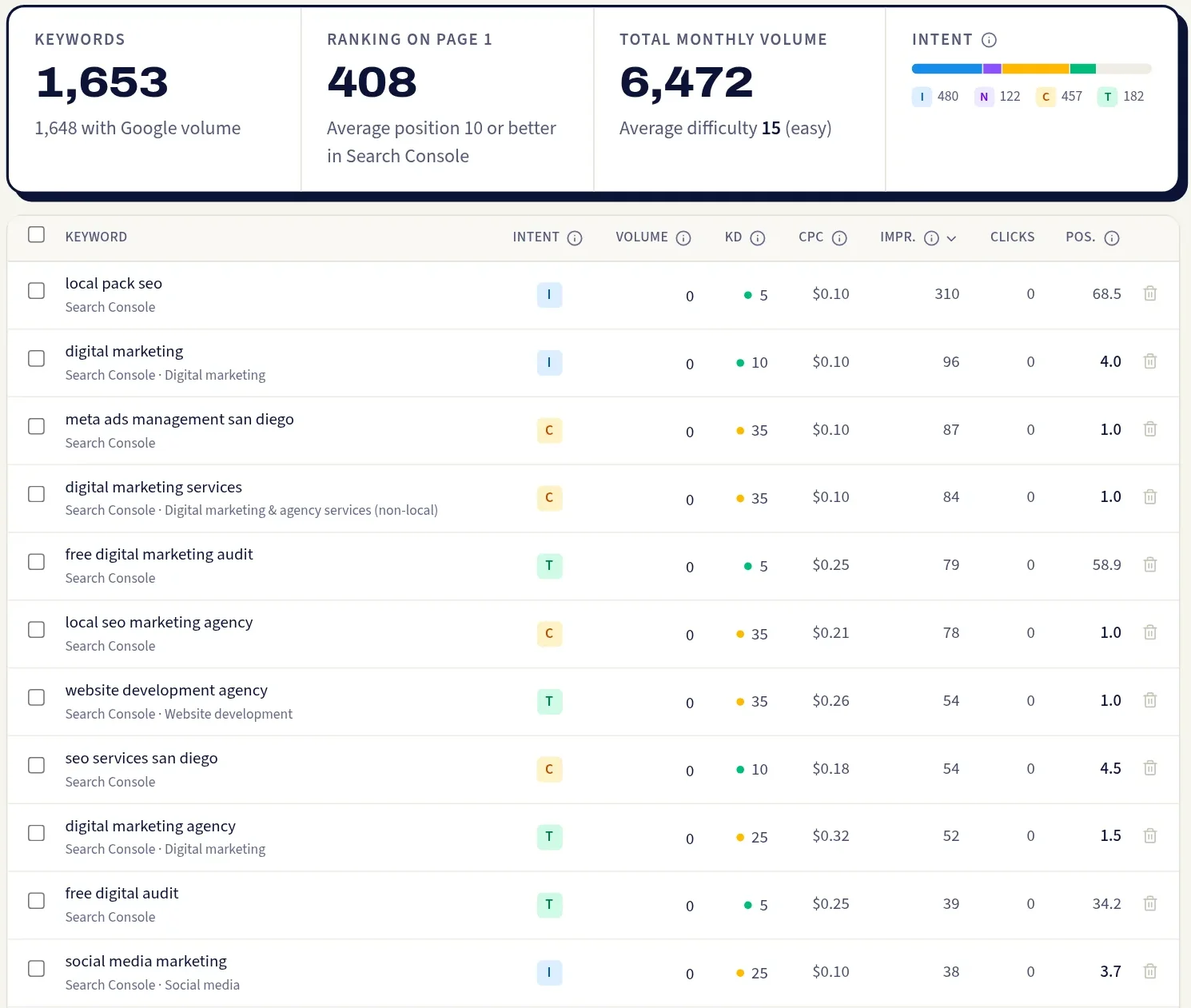 Keyword research in RankThat: volume, difficulty and intent per keyword, then grouped into the pages a cluster needs.
The implant cluster Brightside planned:
| Page | Type | Main searches |
|---|---|---|
| Dental implants in Columbus | Pillar (service page) | dental implants Columbus, implant dentist |
| How much do dental implants cost | Cluster | dental implant cost, implants with insurance |
| Dental implants vs bridges vs dentures | Cluster | implants vs bridge, implants vs dentures |
| Bone grafts for implants | Cluster | bone graft for implant, do I need a bone graft |
| Dental implant recovery, day by day | Cluster | implant recovery time, implant pain after |
| All-on-4 and full-arch implants | Cluster | all on 4 implants, full mouth implants |
| Who is not a candidate for implants | Cluster | can I get implants if, implant eligibility |
Record which page targets which keywords in a keyword map. It stops two pages chasing the same search, which causes keyword cannibalization.
Step 3: Build the pillar page
The pillar is the hub. For a service business, it is usually the main service page. For a publisher or store, it can be a long guide.
A good pillar:
- Covers the whole topic at summary level. Each sub-topic gets a short section with the key answer.
- Links to every cluster page from the relevant section, with descriptive anchor text.
- Does its own job. Brightside’s pillar still has to convert: who it is for, what the process is, prices or price ranges, the dentist, reviews and a booking button.
- Is not a wall of text. If a section grows beyond a few paragraphs, it probably deserves its own cluster page.
Step 4: Write the cluster pages with real depth
Each cluster page answers one sub-topic better than anything else ranking. That means:
- Answer first. The question in the heading, the answer in the first two sentences.
- Experience the others lack. Brightside’s bone graft page explains what their surgeon checks on the scan and how long healing takes in their practice, with an illustration. A generic article cannot.
- Entities and follow-up questions. Name the concepts an expert would expect and answer the next question a reader has. Our semantic SEO guide covers how to map these.
- A clear next step. Back to the pillar, to a related cluster page, or to booking.
Plan each page with a brief before writing. Our guide on how to write a content brief walks through the process, and the content brief template gives you a copyable starting point.
Publish the cluster over weeks, not years. A cluster that is half finished for twelve months sends a weaker signal than one built out over a quarter. Brightside published the implant pillar update and six cluster pages over ten weeks, one every week or two.
Step 5: Link the cluster tightly
Internal links are how search engines see the cluster as a cluster. Google’s link best practices ask for crawlable links with descriptive anchor text, and that is most of what a cluster needs.
| Link | From | To | Example anchor |
|---|---|---|---|
| Down | Pillar | Each cluster page | “how much dental implants cost” |
| Up | Each cluster page | Pillar | “dental implants at Brightside” |
| Across | Cluster page | Related cluster pages | “implants vs bridges” from the cost page |
| In | Blog posts, location pages, FAQs | Pillar or cluster pages | “implant dentist in Dublin” |
Rules we follow:
- Link where it helps the reader, inside the body text, not only in a related-posts block.
- Use anchor text that describes the target page. Vary it a little; do not repeat one exact phrase everywhere.
- Every cluster page links to the pillar. A cluster page with no links in is an orphan page.
- Link out of the cluster sparingly. A link from the implant pillar to the aligner pillar is fine. Links to every service in the sidebar dilute the signal.
RankThat’s Opportunities page suggests internal links between related pages, which is a useful check after a cluster goes live.
Step 6: Find and fill coverage gaps
Once the cluster exists, look for what is missing:
- Search Console queries. Queries that bring impressions to the pillar but have no dedicated section or page are gaps. Brightside’s pillar showed impressions for “implant failure signs” with no section on it. That became a new cluster page.
- Competitor coverage. List the sub-topics competitors’ clusters cover that yours does not, then check each one is worth a page. RankThat’s competitor analysis shows the keywords tracked competitors rank for that you do not.
- People also ask for each cluster page’s main search. New questions appear over time.
- Customer questions. Keep logging them.
In RankThat, the Topical Authority Map shows each keyword cluster as covered, in progress or a gap, with a coverage bar and the keywords inside it. For a cluster marked as a gap, “Fill Gap” creates topic ideas for the missing pages, which you can turn into briefs and articles.
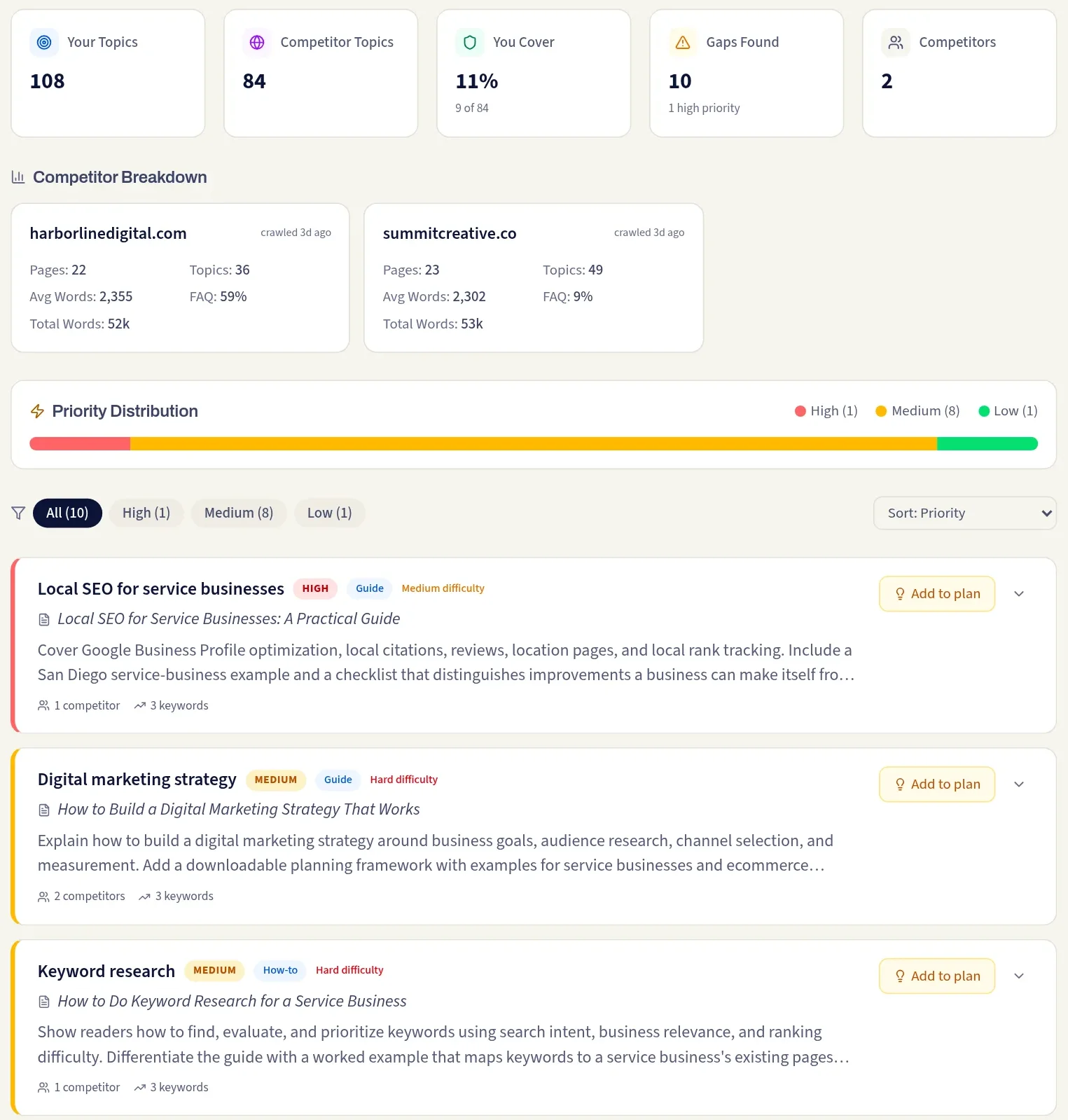 Content Gaps in RankThat. Topics competitors cover that the site doesn’t, each with a suggested article and its priority.
Step 7: Keep the cluster fresh
Authority fades if the content does. Prices change, procedures improve and competitors publish better pages. That is content decay.
- Review each cluster every six to twelve months. Prices, dates, staff, procedures, screenshots.
- Refresh pages that are slipping. Falling clicks or rankings on a page that used to perform is the cue. Our content refresh guide covers the process.
- Merge pages that overlap. If two cluster pages compete, combine them and redirect the weaker one.
- Keep evergreen pages evergreen. Evergreen content still needs checking; it just changes less often.
How long it takes
For a small business site, a cluster of six to ten pages usually takes a quarter to build and another three to six months to show its full effect. Expect the cluster pages to rank for long-tail searches first, then the pillar to climb for the main term as the cluster fills in. Track the whole keyword group, not one keyword, so you see the progress.
Common mistakes
- Too many topics at once. Ten half-finished clusters build no authority anywhere.
- Thin cluster pages written only to fill a map. Each page needs its own reason to exist.
- No links between the pages. A cluster in your planning sheet is not a cluster to Google.
- Two pages for the same search. Check the keyword map before writing.
- Publish and forget. A cluster that was the best source two years ago may not be now.
FAQ
Is topical authority a Google ranking factor?
Google does not publish a “topical authority” score. The term describes an effect: sites that cover a subject thoroughly, accurately and from experience tend to rank better across that subject. The underlying work is what Google’s helpful content guidance asks for.
How many pages do I need to build topical authority?
It depends on the topic. A narrow topic might need five or six good pages. A broad one, such as dental implants for a specialist practice, might need fifteen or more. Cover the sub-topics people actually search for and ask about, then stop.
Can a small site build topical authority?
Yes, and small sites often do it faster because they can focus. A local business with ten excellent pages on its main service often outranks national sites with one general article.
What is the difference between a pillar page and a cluster page?
The pillar covers the whole topic at summary level and links to every cluster page. Each cluster page covers one sub-topic in depth and links back to the pillar.